


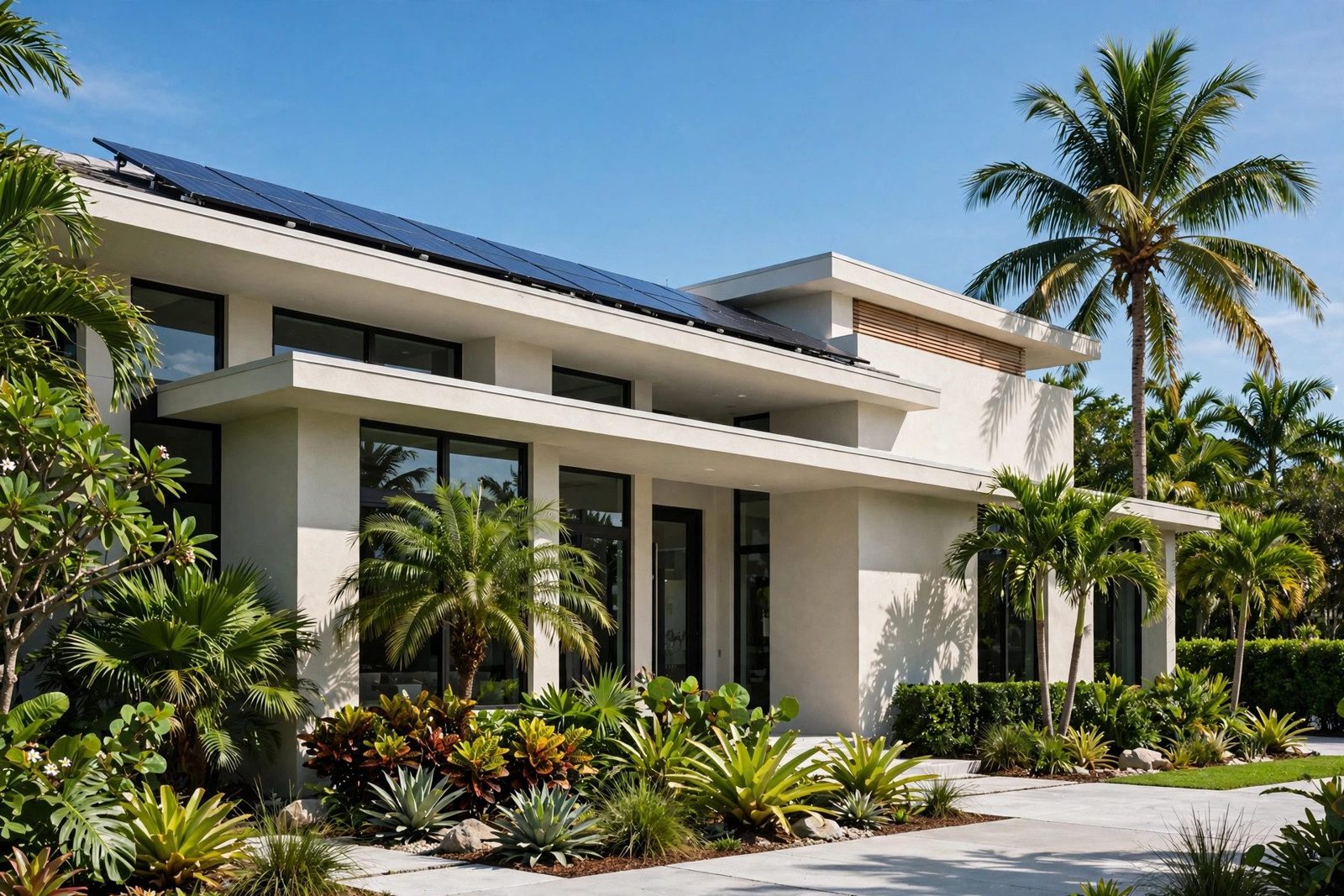
Most advice about energy-efficient homes is written for cold climates — big south windows to gather winter sun, thick walls to hold the heat. Build that house in Naples and you haven't built an efficient home. You've built an oven with a view.
In Southwest Florida, efficiency runs in the opposite direction. The sun is not a heating resource here; it's the load. The most energy efficient home style for Florida is the one designed from the start to keep heat and humidity out, so the air conditioner — the biggest energy consumer in almost every Florida home — can loaf instead of labor. Here's what that actually looks like.
Start with the real enemy: cooling and humidity
In a northern home, heating dominates the energy bill. In Naples, cooling does — air conditioning is typically the largest single share of a Florida home's electricity use, and it runs, to some degree, most of the year. Layer on our humidity, which the system also has to wring out of the air, and the design brief writes itself: every unit of heat the house keeps out is a unit the AC never has to remove. Efficiency in Florida is won or lost at the roof, the windows, and the shade line — long before you shop for a fancier air conditioner.
Shade before machinery
The cheapest cooling in Florida is the heat that never gets in. Well-designed Florida homes stretch their long axis east to west, put as little glass as possible on the punishing western side, and shade what's left: deep roof overhangs, covered lanais to the south and west, and palms and shade trees placed where the afternoon sun lands. Low-E, tinted impact windows do the rest — in this market they're already standard for storm protection, and the same glazing that shrugs off hurricane debris also rejects solar heat. Shade is the one efficiency system that never breaks, never needs a service call, and works during a power outage.
The roof does the heavy lifting
Your roof takes the full force of the Florida sun all day, so its color and material matter more here than almost anywhere in the country. Light colors, and especially metal and tile, reflect heat that a dark shingle roof absorbs and radiates into the attic. Underneath, generous attic insulation and proper ventilation keep what's left from reaching the living space. There's a second payoff Naples homeowners appreciate: roof age and condition already drive insurance costs in Florida — an efficient roof and an insurable roof are usually the same roof.
Build tight, then cool right
Once the heat is kept out, the mechanical system can be smaller and smarter. A tight, well-sealed envelope keeps humid outside air from sneaking in through every gap. A right-sized, high-efficiency (high SEER2) heat pump then does the cooling — and right-sized is the operative phrase. An oversized unit in Florida cools the air in short bursts and shuts off before it has removed the moisture, leaving a house that reads 74° and still feels clammy. Ducts run inside the conditioned space, a smart thermostat, and controlled fresh air complete a system designed around dry as much as cool.
Don't forget the pool
In most Naples homes, the second-biggest energy draw isn't in the house at all — it's the pool pump, historically run for hours a day at full speed. Variable-speed pumps sip power by comparison, running longer at a fraction of the speed; Florida's energy code has required them on most new pool installations for years, and they're among the fastest-payback upgrades on an older home. Add a timer, LED lighting, and solar pool heating — abundant and cheap in this climate — and the backyard stops quietly inflating the FPL bill.
Solar finally makes sense here
If any roof in America earns its solar panels, it's one in Southwest Florida, under some of the most reliable sunshine in the country. Rooftop solar paired with FPL's net metering can take a serious bite out of a cooling-dominated bill, and it pairs naturally with a long-life metal or tile roof — you don't want to mount panels on shingles you'll replace in ten years. More Naples buyers are also adding battery storage, which turns a solar roof into something else entirely during storm season: lights, refrigeration, and a fan or two while the grid is down. That's not an energy feature anymore. That's peace of mind with a payback period.
Buying? The Florida efficiency checklist
When you tour homes in Naples, the efficiency story is readable if you know where to look:
- Orientation and shade — how much unshaded glass faces west, and whether lanais and overhangs protect it.
- Windows — impact-rated, low-E, and tinted beats clear single-pane every time, in both the energy bill and the insurance quote.
- Roof — light color, reflective material, and its age; the attic's insulation above the ceiling matters as much.
- Cooling system — the AC's age and SEER2 rating, whether it looks sensibly sized for the house, and where the ducts run.
- The pool equipment pad — a variable-speed pump is a quiet tell that the owner maintained the home with energy in mind.
- Solar, if present — owned or leased, its age, and whether a battery backs it up.
For new construction, ask the builder for the home's energy rating outright — most reputable Florida builders can provide one. For a resale, a year of the seller's FPL bills tells you more than any brochure: ask for them.
The bottom line: the most energy efficient home style in Southwest Florida isn't a style at all. It's a set of decisions — shade, reflection, sealing, right-sized cooling, smart pool equipment — that Mediterranean, coastal contemporary, and Key West designs alike can all make. Homes that made them cost less to run, feel better to live in, and increasingly, sell for it.
Thinking about building or buying in Naples?
Energy-smart design matters more every year in Florida. Talk to us about what's available — new construction and resale alike.